Entity-First Search: How Local Businesses Become the Answer AI Systems Recommend
AI systems do not search through text. They query structured representations of real-world entities. Understanding that distinction is the first step toward becoming the business AI recommends.
Mark Abplanalp
May 9, 2026
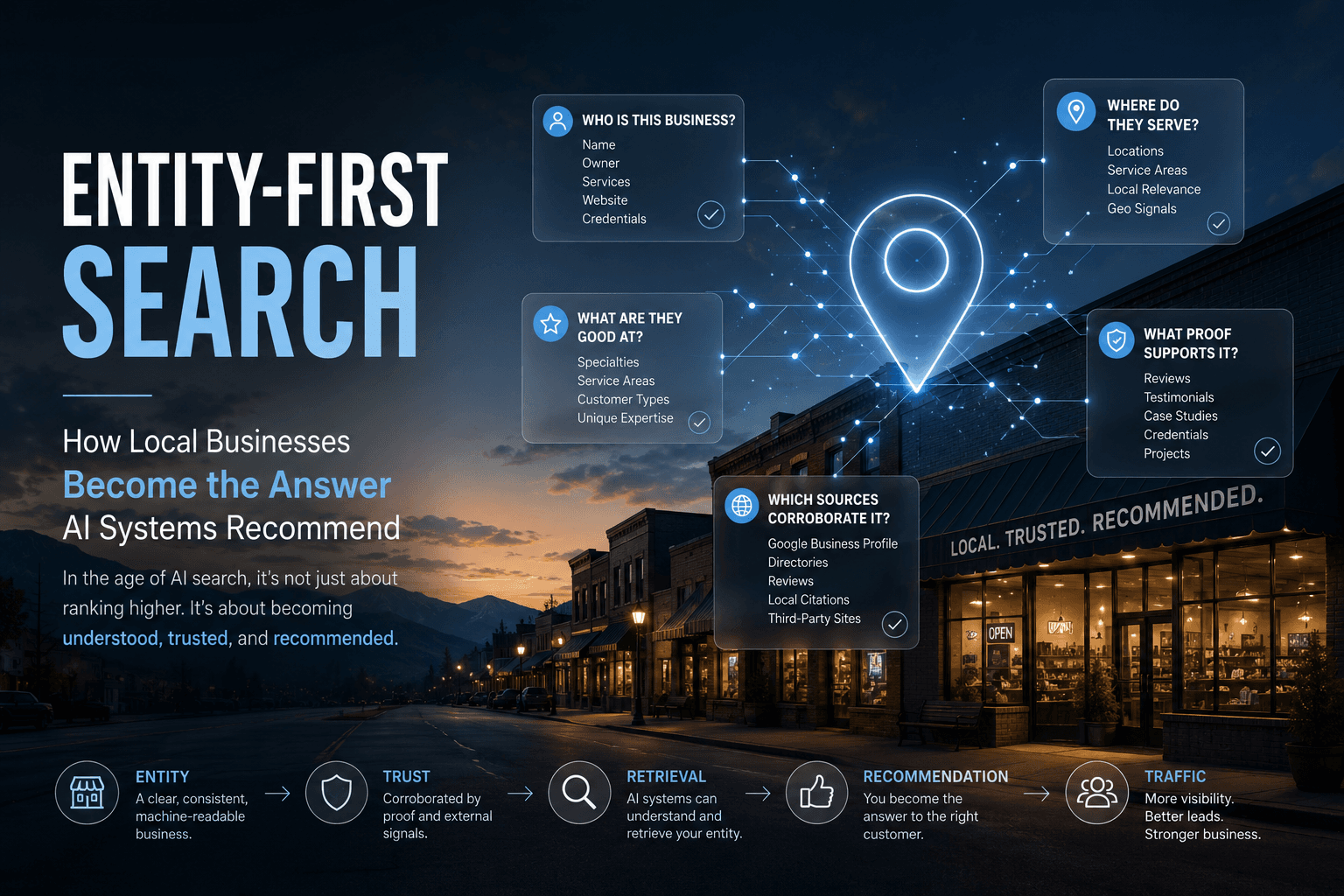
There is a question every local business should be asking in 2026: when someone asks an AI assistant for a recommendation, how does the system decide who to suggest?
The answer starts with entity. Not content volume. Not backlink count alone. Not review quantity in isolation. Those signals matter — but they feed into something more fundamental. AI systems organize their understanding of the world around entities: real things with attributes, relationships, and verifiable properties.
THE CORE IDEA
A local business that wants to be recommended by AI needs to be understood as a clear, trusted entity — not just a website with pages. That is what entity-first search means.
What Is Entity-First Search?
Entity-first search describes how modern AI systems and search engines approach information retrieval. Instead of indexing pages and matching text to query keywords, they build structured representations of the things in the world — people, businesses, places, services, events — and query those representations directly. This is the same principle behind Google's Knowledge Graph, launched in 2012 with the tagline “things, not strings.”
Search Used to Be About Words. Now It Is About Things.
In traditional SEO, you optimized text. You researched keywords people were typing, wrote content using those keywords, earned backlinks to signal importance, and waited for the algorithm to rank your page. The system matched strings of text to strings of text in the query.
That model still exists. But it is not the full picture of how AI systems decide who to recommend. Modern AI systems — and the knowledge layers underneath them — ask different questions:
- ›What kind of thing is this?
- ›What does it do?
- ›Where does it operate?
- ›Who is connected to it?
- ›What do external sources say about it?
- ›Is it consistent, verifiable, and trustworthy?
These are entity-level questions. Answering them requires more than content. It requires structure.
An Entity Is What Something IS, Not Just What It Says About Itself
A business entity is not its homepage copy. It is the totality of machine-readable information that defines the business. That includes:
Business type (LocalBusiness subtype)
Name, address, phone, service area
Owner and practitioners
Services and specializations
External profiles (Google, Bing, Apple, BBB, Yelp)
Credentials and certifications
Reviews, citations, third-party mentions
Content, FAQs, videos, owned proof assets
A business can write excellent content and still have a weak entity. Conversely, a business with a clean, consistent, well-connected entity is easier for AI systems to recall, verify, and recommend — even with less content.
Entity-First Means the Entity Comes Before the Content
The practical implication: content strategy should follow entity strategy. The entity graph defines what the business is. Content amplifies and expands that definition. When the entity is unclear, content adds noise. When the entity is clean, content compounds.
Most local business websites are built in the wrong order — full of content with no structured entity underneath. That is the gap.
Why the Old SEO Model Is No Longer Enough
The Evolution From Keywords to Topics to Entities
SEO has moved through generations. First-generation SEO was keyword-centric: match the page to what people typed. Second-generation was topic authority: build enough content depth to signal expertise. Third-generation — where AI systems operate — is entity-centric: become a clearly defined, verifiable entity in the knowledge layers underneath search. The vocabulary that makes this possible is Schema.org, the shared structured-data standard co-founded by Google, Bing, and Yahoo in June 2011.
Each generation still matters. Keywords inform content. Topic depth still builds authority. But neither alone is sufficient when AI systems need to recommend specific businesses for specific queries with high confidence.
The Problem With Platform-Dependent Websites
Many small businesses built their web presence on WordPress, Wix, or Squarespace. Those platforms are designed for human visitors — not machine extraction. They typically produce:
- ›Bloated HTML that exhausts AI token budgets before the key information is found
- ›Schema generated automatically by plugins, often with errors or wrong types
- ›JavaScript-rendered content that AI crawlers may not see on a cold load
- ›No coherent entity graph — just page after page with loosely related content
The result is a website that looks fine to a human visitor but sends confusing, incomplete, or conflicting signals to AI systems. Google's own JavaScript SEO guidance recommends server-side or pre-rendering for exactly this reason — not all crawlers run JavaScript, and content trapped behind client-side rendering may never get indexed.
What AI Systems Actually Evaluate
When an AI system encounters a business, it is not running a keyword match. It is asking:
THE MACHINE'S EVALUATION
Resolvability
Can I identify this as a real, specific business entity?
Consistency
Does information about this business match across multiple sources?
Extractability
Can I pull key attributes without ambiguity?
Relevance
Is this business relevant, trustworthy, and local enough for this query?
The Entity Graph
An entity graph is not one schema tag on one page. It is a network of structured relationships that connect every part of the business into a coherent, machine-readable whole.
An Entity Graph Is Not One Schema Tag
Most discussions of schema markup focus on individual page types. A homepage gets LocalBusiness. A blog post gets BlogPosting. A service page gets Service. That is a start. But individual schemas on individual pages do not constitute an entity graph.
An entity graph connects those schemas through shared identifiers — @id references — so that the business, its founder, its services, its location, its articles, its videos, and its reviews all point to the same entity. The connection matters as much as the individual declarations.
The Nodes and Relationships That Matter
A complete entity graph for a local business includes:
Organization node (@id: /#organization)
Founder node (@id: /#founder)
Website node (@id: /#website)
Service nodes → connected to organization
Location nodes → with geo coordinates
Article nodes → isPartOf → website
FAQ nodes → on key landing pages
Video nodes → when embedded on site
sameAs references → all verified profiles
Every node reinforces every other node.
Why Consistency Across the Web Matters
Entities are not just defined by what is on the website. They are corroborated by what exists across the web. AI systems cross-reference the website against Google Business Profile, Bing Places, Apple Business Connect, BBB, Yelp, Yellow Pages, Houzz, Reddit, and industry-specific directories. If the business name, address, or phone number is inconsistent across these sources — different spellings, old addresses, missing profiles — the entity signal weakens. Corroboration requires consistency.
How AI Systems Use Entity Graphs
AI Systems Cross-Reference Signals Before Recommending
When a user asks an AI assistant “who is the best HVAC company in my area,” the system is not simply pulling the nearest keyword match. It is evaluating a set of businesses against a confidence threshold. The businesses that get recommended are the ones the system can most confidently verify as relevant, local, credible, and trustworthy.
Corroboration Beats Repetition
The old SEO instinct was to repeat. If the keyword appeared twenty times on the page, the page would rank for it. Entity-first search works differently. Repetition does not increase confidence. Corroboration does.
A business mentioned consistently across Google, Bing, Apple Maps, BBB, Yelp, and Yellow Pages — with matching NAP data and consistent service descriptions — is easier for an AI system to corroborate than a business that only defines itself on its own website.
Why AI Systems Default to Safe, Clear Entities
AI systems err toward confidence. If the evidence around a business is ambiguous, the system may simply not recommend it — not because the business is bad, but because the evidence is unclear. An inconsistent NAP, a wrong business type in schema, a WordPress site with conflicting plugin markup, a Google Business Profile that has not been updated in three years — all of these create hesitation. Google's own structured data guidelines are explicit that markup must match the visible content of the page; mismatched signals weaken confidence.
THE SAFEST PATH
The safest path to being recommended is being easy to verify.
Not the loudest. Not the most prolific. The clearest.
What a Complete Entity Graph Looks Like for a Local Business
Business Identity Layer
People and Credentials Layer
Services, Locations, and Proof
Content Layer
The Five Most Common Entity Gaps
Most local businesses have entity gaps they are not aware of. Here are the five that appear most consistently — and matter most.
Inconsistent NAP Across Directories
The business name or phone number is slightly different on Google than on Yelp. The address uses "Suite 4" in one place and "#4" in another. These inconsistencies are invisible to humans but highly visible to AI crawlers.
Schema Present but Wrong Type
WordPress plugins often generate schema errors or apply a generic Organization type when the site needs a more specific subtype — DentalPractice, HomeAndConstructionBusiness, LegalService. Wrong types miss out on the richer signals those subtypes carry.
Reviews Disconnected From Service Pages
Hundreds of Google reviews exist for the business but are not referenced in schema. No aggregate rating, no structured proof layer connecting reviews to specific services. The reviews exist only as off-site signals.
Provider Identity Missing
The business has no Person schema for the owner or lead practitioner. A dental practice has four dentists but zero person schema for any of them. AI systems cannot resolve the human behind the service.
Platform-Dependent Conflicting Markup
WordPress, Wix, and Squarespace often add their own meta tags, Open Graph, and schema that conflicts with or duplicates markup from SEO plugins. The result is contradictory signals. AI systems may not know which to trust.
How to Build Your Entity Graph the Right Way
The Website as the Entity Anchor
The website should be the source of truth. Not a Google profile. Not a Yelp page. Not a brokerage listing. The website should define the entity clearly, with structured JSON-LD that declares the business, its people, its services, its locations, and its content.
The right relationship:
The website defines the entity.
Google Business Profile corroborates it.
Bing Places corroborates it.
Apple Business Connect corroborates it.
Yelp, BBB, and Yellow Pages support it.
Industry directories support it.
Everything should point back to one clear business identity.
Directories That Corroborate
After the website is clean and structured, external profiles should be updated to match exactly: Google Business Profile, Bing Places, Apple Business Connect, BBB, Yelp, Yellow Pages, and industry-specific directories — Houzz for contractors, Avvo for attorneys, Healthgrades for medical, NMLS for mortgage, and others. NAP consistency is non-negotiable. Business type and service descriptions should match.
Schema That Declares and Connects
The entity graph is built with JSON-LD. The key principles:
- ›Use @id references to connect nodes, not just inline type declarations
- ›Use specific subtypes where available (DentalPractice, not Organization)
- ›Connect articles back to the organization via publisher and isPartOf
- ›Connect practitioners to the organization via memberOf and worksFor
- ›Connect services to the organization via provider
- ›Use sameAs to list all verified external profile URLs
Validate everything with the Schema Markup Validator and Google's Rich Results Test before shipping.
Entity-First Search in Practice
The HVAC Example
A local HVAC company has been in business for 22 years. The owner is a master technician with multiple certifications. They have 340 Google reviews averaging 4.9 stars.
Old model:
A WordPress website with a homepage, contact page, and three service pages with thin, generic content. Schema from a plugin that declares Organization and nothing else.
Entity-first model:
A Next.js site with the company as an Organization entity connected to the owner as a Person entity with certifications, individual service pages (heating installation, AC repair, furnace maintenance) each with Service schema, an FAQ page addressing real customer questions, project pages for large jobs, video schema for how-to content, and consistent profiles on Google, Bing, Apple Business Connect, BBB, and Yellow Pages — all pointing back to the same entity. When a voice assistant is asked “who does the best HVAC work in [city],” the entity-first site gives the AI enough to work with to recommend confidently.
The Dentist Example
Old model:
A Wix website with a few service pages, a bio for the dentist, and a contact form. The Google Business Profile is accurate. The Yelp listing is outdated. Schema is auto-generated and generic.
Entity-first model:
A clean site with DentalPractice schema connected to the dentist as a Person entity with credentials, individual service pages for general, cosmetic, orthodontic, and restorative dentistry — each with Service schema — patient FAQ answers with FAQPage schema, staff pages for associates, an aggregate review reference, video schema for the welcome video, and sameAs links to Google, Yelp (updated), Apple Business Connect, and Healthgrades.
The Realtor Example
Old model:
Top-producing realtor with profiles on Zillow and Realtor.com. Their own website is a page on the brokerage domain. There is no entity anchor they control. Their best proof lives on platforms they do not own.
Entity-first model:
Owned domain with Person schema for the realtor, service connections for buyer representation, seller representation, and relocation, sameAs links to Zillow and other profiles, a sold-property archive, transaction-based blog content linking to service pages, and FAQ schema addressing buyer and seller questions. The realtor now owns their entity anchor and builds authority on a foundation they control.
Making AI Systems Recommend You
Entity-first search is not a single fix. It is a strategy for how a business presents itself to machines. The goal is not to trick an AI system — it is to be easy to understand, verify, and trust.
The businesses that get recommended by AI are not always the best in their market. But they are almost always among the clearest. Clarity, consistency, and corroboration compound over time.
THE THREE PRINCIPLES
Clarity
The business entity is precisely defined in machine-readable schema — correct type, correct attributes, correct relationships.
Consistency
Every external profile matches the website exactly. NAP data, business type, service descriptions, and contact details align.
Corroboration
Multiple independent sources confirm the same entity. The website declares it. Google confirms it. BBB supports it. Industry directories reinforce it.
A business that invests in its entity graph in 2026 is not just improving its SEO. It is building the foundation that will determine whether it gets recommended by the AI systems, voice assistants, and agentic tools that define local discovery for the next decade.
That foundation is what KodeCite builds.
Frequently Asked Questions
What is entity-first search?
Entity-first search describes how modern AI systems and search engines organize information around things — people, places, businesses, services — rather than around text and keywords. A local business that wants to appear in AI recommendations needs to be understood as a clear, verifiable entity, not just a page with content.
How is entity-first search different from traditional SEO?
Traditional SEO focused on keywords, content volume, and backlinks. Entity-first search focuses on structured identity: is the business clearly defined, consistently corroborated across the web, and connected through machine-readable schema? Both approaches overlap — strong SEO still matters — but entity signals determine whether an AI system can confidently recommend a business when the recommendation set is small.
What is an entity graph for a local business?
An entity graph is the full network of structured, machine-readable relationships that connect every part of a business into a coherent identity. It includes the business organization node, founder and practitioner nodes, service nodes, location nodes, article nodes, and external profile references — all linked through shared @id identifiers in JSON-LD schema so AI systems can understand the business as a connected whole.
How do AI systems use entity information to decide who to recommend?
AI systems evaluate businesses against a confidence threshold, cross-referencing the website against external sources — Google Business Profile, Bing Places, Apple Business Connect, BBB, Yelp, Yellow Pages, and industry directories — looking for consistency in name, address, phone, business type, and service descriptions. Businesses easy to verify across multiple sources are safer to recommend. Businesses with inconsistent or ambiguous entity signals are often filtered out.
What are the five most common entity gaps local businesses have?
The five most common entity gaps are: inconsistent NAP data across directories; schema using wrong business types; reviews disconnected from service pages with no structured proof layer; missing provider or practitioner identity schema; and platform-dependent markup from WordPress, Wix, or Squarespace plugins that conflicts with or duplicates structured data, sending contradictory signals to AI systems.
Does adding schema markup alone make a strong entity?
No. Schema markup declares the entity, but a strong entity graph requires corroboration. A business can have perfect JSON-LD on its website and still have a weak entity if external profiles are inconsistent, provider identity is missing, or the site cannot be crawled cleanly. Schema is a necessary first layer, not the complete solution.
How does Google Business Profile connect to my entity graph?
Google Business Profile is a corroboration node — it should match what the website declares, not define the entity in place of the website. The website defines the entity through JSON-LD schema. Google Business Profile, Bing Places, Apple Business Connect, and other directory profiles then corroborate that definition with consistent NAP data, business type, and service descriptions.
Does it matter which website platform I use for entity-first search?
Yes, significantly. WordPress, Wix, and Squarespace produce bloated HTML that consumes AI token budgets, JavaScript-rendered content that AI crawlers may not see on a cold load, and schema generated by plugins that is often wrong or conflicting. A purpose-built Next.js site with server-side rendering and clean JSON-LD gives AI systems accurate signals on the first crawl without ambiguity.
Can a business with great reviews but weak entity signals still get recommended by AI?
Possibly, but inconsistently. Reviews are a corroboration signal — they help, but they do not replace a structured entity. If the business name, address, or business type is ambiguous in schema, AI systems may struggle to connect those reviews to the right entity. A strong entity graph makes every corroboration signal — including reviews — count more.
What is the first step toward building a stronger entity?
The first step is an honest audit of your current entity signals: what schema exists on the site and whether it is correct, whether NAP data is consistent across all external profiles, whether provider identity is declared, and whether the website can be crawled cleanly without JavaScript dependency. A Machine Read — which is what KodeCite offers at no cost — shows you what AI systems can currently verify about your business and where the highest-priority gaps are.
YOUR ENTITY GRAPH STARTS HERE
Find out what AI can actually verify about your business.
An Agent Readiness Review shows where the business is understandable — and where a safe next action is still missing.