The F1 Framework for AEO: Why Most Businesses Are Trying to Win the AI Race in an Economy Car
Most AEO advice focuses on the wrong layer. The businesses winning AI discovery built the stack in the right order — chassis, engine, aero, graphics. Here is what that means and how to sequence the work.
Mark Abplanalp
April 23, 2026
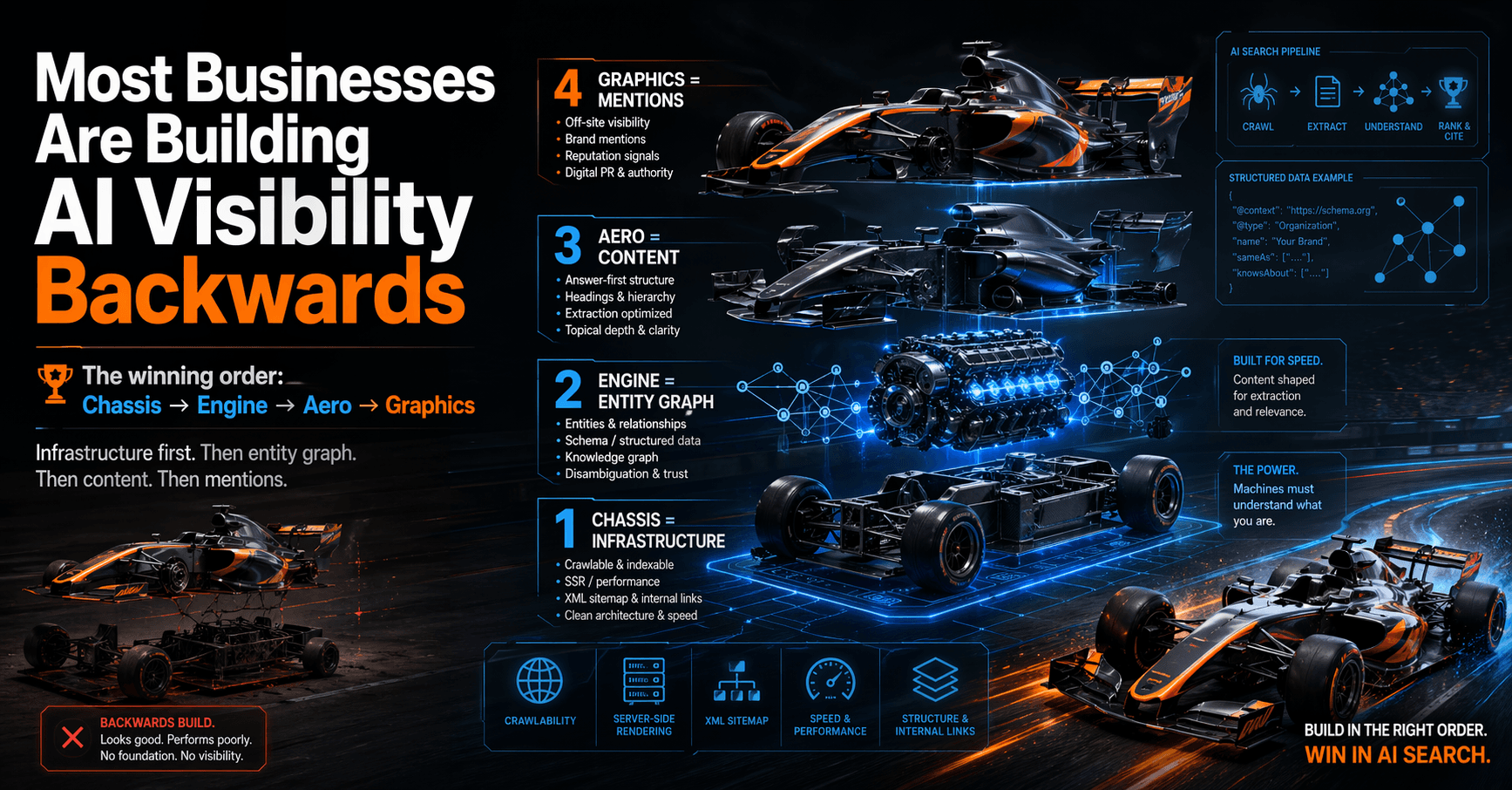
Most of the conversation about AI search visibility right now is focused on the wrong layer. Agencies are selling brand mentions, Reddit tactics, citation building, and content volume — all of which matter, but none of which work in isolation. The businesses winning the AI discovery game aren't winning because they got their content on the right Reddit thread. They're winning because everything underneath that content is built correctly.
The best way to understand this is to borrow a framework from Formula 1.
How an F1 Team Actually Builds a Winning Car
A Formula 1 team doesn't start building a car by picking out which sponsor logos will go on the side. They don't start with the paint job. They don't even start with the aerodynamic package. They start with the chassis — the structural foundation that determines how every other component will perform.
Then they build the engine. Because without a properly engineered engine matched to the chassis, the car can't generate the power it needs to compete.
Then comes the aerodynamic package — the bodywork, the wings, the ducts — all designed to channel air efficiently so the engine's power actually translates into speed on the track.
And then, only at the end, do the sponsor logos get applied. Because graphics without performance are just expensive decoration.
THE BUILD ORDER
Every serious F1 team builds in this order: chassis, engine, aero, graphics. Reverse the order and you get a car that looks fast and loses every race.
The AEO and GEO space works exactly the same way. And most businesses — and most agencies selling to them — are working in reverse.
The AEO Stack, Mapped to F1
Here's how the F1 build order translates to how businesses get found by AI search engines like ChatGPT, Perplexity, Claude, and Google's AI Overviews:
Layer 1 — The Chassis is your Infrastructure
This is the underlying website platform. The hosting, the rendering model, the page structure, the crawlability. This is what determines whether AI systems can actually read and extract your content in the first place.
Most small and mid-sized businesses are running what amounts to an economy car on the track. WordPress sites buried under plugin bloat. Wix and Squarespace templates that render everything client-side. Squarespace commerce sites with slow page loads and inconsistent structure. Legacy builds with broken sitemaps, unreliable uptime, and content hidden behind JavaScript that AI crawlers can't see. Google itself recommends server-side or pre-rendering for exactly this reason — not all crawlers run JavaScript, and content trapped behind client-side rendering may never get indexed.
You can bolt the best engine in the world onto an economy car chassis. It still loses to a McLaren.
A proper chassis for AI discovery is a site built on a modern framework — Next.js, Astro, or similar — deployed on edge infrastructure like Vercel or Cloudflare, rendered server-side so crawlers see the content immediately, with clean sitemaps, fast load times, and page structures designed for extraction from the ground up.
This is the layer almost nobody talks about and almost everybody skips. It's also the layer that determines whether any of the work above it actually functions.
Layer 2 — The Engine is your Entity Graph
Once the chassis is right, the engine determines performance. In AEO terms, the engine is your entity graph — the structured data, schema markup, and identity signals that tell AI systems exactly who you are, what you do, where you operate, and what makes you trustworthy.
Run any regional or local SMB's website through a schema validator and the results are almost always ugly. Missing schema entirely. LocalBusiness markup with wrong categories. Person schema that doesn't link to Organization schema. Empty sameAs arrays. Review markup that doesn't match the reviews on the page. No Article schema on blog posts. No FAQPage schema on FAQ pages. No BreadcrumbList hierarchy. Basic mistakes stacked on top of each other.
And for the minority of businesses that have decent schema, there's still enormous room for improvement. Schema isn't just about whether it exists. It's about whether it's wired to reality — whether the entities declared in code actually match the entities on the page, and whether the relationships between them (author to article, business to employee, product to offer) are declared cleanly enough for a machine to resolve without hedging. Google's structured data guidelines are explicit that markup must match the visible content of the page, and you can confirm it with the Schema Markup Validator and Google's Rich Results Test.
Without a clean entity graph, AI systems can't confidently identify who you are. And if they can't identify you, they won't recommend you. They'll recommend whoever has the clearer signal — even if that business is objectively worse than yours.
A well-tuned engine on a broken chassis still loses. But a clean chassis paired with a properly engineered engine — that's where the compounding starts.
Layer 3 — The Aero Package is your Content
With chassis and engine in place, the aerodynamic package channels performance into actual speed. In AEO terms, content is what turns a technically-sound site into one that AI systems can extract, synthesize, and cite.
Most content on the web is structurally useless for AI extraction. Articles buried in walls of text with no clear hierarchy. H1s that don't answer questions. Long-winded introductions that force a model to hunt for the actual information. No FAQ sections. No clear relationships between ideas. No structured summaries.
Properly structured content for AI discovery follows a different pattern. Answer-first H1s. H2 hierarchy that maps to specific questions buyers are actually asking. Short, extractable paragraphs. FAQ sections wired to FAQPage schema. Internal linking that reinforces entity relationships. Content that's written to be cited, not just read.
But here's the catch that most content marketers miss: without the engine (entity graph), content has nothing to attach to. The model reads the article, finds good information, but can't confidently resolve which business the article is recommending. Without the chassis (infrastructure), the content doesn't even get rendered to the crawler in the first place.
Content is critical. It's also the third layer, not the first.
Layer 4 — The Graphics are your Mentions
Finally, the sponsor logos. The graphics. The loud branding on the side of the car.
In AEO terms, this is your off-site mention layer. Press coverage, directory listings, Reddit threads, guest posts, citation-building, social media presence, third-party reviews. Everything that happens outside your site but points back to your brand.
These matter. Mentions are a real signal to AI systems — they increase the probability your business gets surfaced as an answer. But they're the fourth layer for a reason.
A sponsor will not pay to put their logo on a car that can't win. And even if the sponsor does pay, nobody wants to see their logo driving in circles while other teams lap them.
The practical version of this: a brand mention in a great article points to your website. If the website is structurally broken, the entity signals are confused, and the content can't be extracted cleanly, the mention dead-ends. The AI system reads the mention, tries to resolve it to a real entity, fails to resolve it confidently, and moves on to a competitor whose foundation is actually readable.
Mentions work on top of the stack underneath them. They don't replace it.
Why the Industry Is Selling This Backwards
If the right order is chassis, engine, aero, graphics — why is most of the AEO and GEO industry selling the reverse?
Because the graphics are easy to sell, and easy to teach, and easy to show in a case study. “Here's how we got your brand mentioned in X” is a clean deliverable. “Here's how we rebuilt the foundation of your website so that AI systems can read it correctly” is a longer conversation, a bigger investment, and a less Instagram-friendly before-and-after.
The foundation work is slow. It's technical. It's unsexy. It's also the only work that compounds.
Most agencies are incentivized to sell the fast win because that's what buyers ask for. Buyers come in saying “I want to show up in ChatGPT” and the agency sells them the tactic that's easiest to deliver. The foundation stays broken. The mentions generate short-term movement. The results plateau. The client churns.
The businesses that win long-term are the ones who let somebody rebuild the chassis first — even if the first six months feel slower than just buying content placements.
The Competitive Opening for Regional and Local Businesses
Here's what makes this moment genuinely unusual: most of the market is getting this wrong.
Enterprise brands have the budgets and the technical teams to build the stack correctly. They're already doing it. The businesses being recommended by ChatGPT when someone asks about a category are increasingly the ones who invested in the infrastructure early.
At the regional and local level, the market is wide open. The vast majority of local service businesses — law firms, financial advisors, medical practices, home services, real estate teams — are running on economy car chassis with missing engines and no aero package at all. They're competing on graphics alone, which means they're not really competing.
The first mover in each category — the first regional law firm, the first local real estate team, the first area med spa — that commits to building the stack correctly doesn't just win a little. They become the default answer. AI systems compress the field to one or two names per category per region. There's no page two of recommendations. Whoever builds the foundation first owns the citation.
The window for this is real but finite. The expectation over the next 18 to 24 months is that this becomes standard practice at the regional level. The businesses that move now will own their markets by the time the rest of the industry catches up.
How to Actually Sequence the Work
If this framework is right, the practical implication is clear: fix the layers in order.
- 1. ChassisAudit the platform, the rendering, the page structure, the crawlability, the sitemap, the hosting, the core technical foundation. If the site is built on a platform that fundamentally can't support what needs to come next, nothing above it will work.
- 2. EngineGet the schema right. Declare the entities. Wire the relationships. Fill the sameAs array with real, verified URLs. Get Person, Organization, LocalBusiness, Article, and FAQPage markup aligned with what's actually on the page.
- 3. AeroRestructure the content so it's answer-first, extractable, and wired to schema. Build out FAQ sections. Create the internal linking hierarchy that reinforces entity relationships.
- 4. GraphicsBuild the mention layer. Pursue press, directory listings, Reddit presence, social signals, third-party citations. With the foundation in place, the mentions start working the way they're supposed to.
Every layer compounds with the ones beneath it. Every shortcut skipped is a leak in the overall performance of the car.
The Race Is Already Underway
The businesses being surfaced by AI search engines today are the ones that started building this stack correctly two years ago. The businesses being surfaced two years from now are being built right now.
If you're running a regional or local service business and you've been wondering why your visibility isn't improving despite the content you're producing or the mentions you're buying — the answer is almost certainly underneath. The graphics look fine. The chassis is the problem.
You can't win an F1 race in an economy car. No matter how good the paint job is.
YOU CAN'T WIN AN F1 RACE IN AN ECONOMY CAR
Fix the Foundation. Then Everything Else Compounds.
The False Legacy Layer is real — and it has an expiration date. An Agent Readiness Review shows what AI can understand, verify, and safely do with your business today.